
How to Choose Among Gemini 4 Argon, GPT-6 Astra, and Claude Fable 5.1? Availability, Pricing, and Use Case Comparison
Gemini 4 Argon is limited to testers. Compare GPT-6 Astra and Claude Fable 5.1 by availability, task, subscription and API price using official data, not head-to-head tests.

Sources checked: September 30, 2026 (UTC). PandaNpc provides AI Agent services, and this is related to model selection. This article compiles publicly available information from the three companies and gives task-based selection advice; we have not yet obtained trial access to Gemini 4 Argon, and we did not run same-condition tests on all three models. In the following text, “suitable” refers to official positioning and current availability; it does not mean we have tested which model is stronger.
Bottom line first: if you need to use it today, choose between GPT-6 Astra and Claude Fable 5.1 based on the task and your existing plan; Gemini 4 Argon is currently open only to a small number of trusted testers, and ordinary users cannot yet treat it as a readily selectable third option. For cross-software operations, complex material organization, or highly difficult programming, you can try Astra first; for long-term programming, repeatedly reading large projects or complex documents, you can try Fable 5.1 first. After Argon becomes broadly available, compare actual completion quality and total cost using the same tasks.
View full-size cover PNG (1672×941)

First, Check Whether You Can Use Them: The Three Models Are Not on the Same Starting Line
| Model | Official release date | Who can use it as of September 30 | What it means for ordinary readers |
|---|---|---|---|
| Gemini 4 Argon | 2026-09-30 | First opened to trusted cyber defenders and testers in Google's Fairwind project; broad availability for developers, enterprises, and consumers is pending later phases | Seeing “released” today does not mean your Gemini account or API can already select Argon |
| GPT-6 Astra | 2026-09-03 | Being rolled out in phases to ChatGPT paid users and API users; specific available quota depends on plan and account | You can check your model list and usage quota, and start real tasks immediately |
| Claude Fable 5.1 | 2026-09-01 | Available on Claude paid plans and Claude API, but plans such as Pro may require additional usage credits | Check your plan's Fable usage rules first, then decide whether to upgrade or pay separately |
Google's Gemini 4 Argon announcement states that it is currently a limited-scope release and that expansion is planned to begin with paid API users and Google AI Ultra subscribers; no definite date for ordinary users has been announced. OpenAI's Astra announcement and Anthropic's Fable 5.1 description respectively explain the current availability scope. Astra here is an OpenAI model, not Google's Project Astra research project.
Parameter Comparison: Don't Confuse “How Much It Can Read” with “How Much It Can Write”
Input context window is how much material can be given to the model at one time; maximum output is how much content it can generate at most in one response. These two numbers cannot be interchanged, and answer quality cannot be judged by the numbers alone. The following are model-specific details verified on September 30, 2026, not general specifications for the entire Gemini, GPT, or Claude families.
| Parameter | Gemini 4 Argon | GPT-6 Astra | Claude Fable 5.1 |
|---|---|---|---|
| Input context window | Official upper limit not announced | 1,050,000 tokens | 1,000,000 tokens |
| Maximum output per run | Google announcement says 1,000,000 tokens; ordinary users cannot yet verify | 128,000 tokens | 128,000 tokens |
| Inputs that can be given to the model | Announcement demonstrates multimodal and long-video understanding, but the full list of API input types has not been announced | Text, images | Text, images |
| Current official access | Fairwind trusted testers; broad availability date not announced | ChatGPT paid accounts according to rollout progress and plan, and OpenAI API | Claude paid products and Claude API; plans such as Pro have additional credit requirements |
Sources: Google's Gemini 4 Argon announcement, OpenAI's GPT-6 Astra model page, Anthropic's Claude Fable 5.1 model page, and Anthropic's plan description. The “1 million” in Google's announcement refers to the output limit, and cannot be taken as Argon having announced a “1 million input context window.” Argon's full public model card and ordinary-user tests are still pending; “not announced” in the table does not mean “lacks this capability.”
The table above compares public specifications, not performance wins or losses: being able to hold more content does not necessarily mean answering more accurately. The table below is the performance benchmark scores.
Official Benchmark Comparison: Look at Specific Tasks, Don't Crown an “Overall Champion”
Google DeepMind published a four-model benchmark table on the Gemini 4 Argon official model page. Here we only extract the three columns for Argon, GPT-6 Astra, and Claude Fable 5.1 discussed in this article; the original table also includes Claude Opus 5.5. The following scores come from the Google official page actually read at 23:42 UTC on September 30, 2026, and were compiled by Google, not by PandaNpc under same-condition tests. Except for rows marked F1, pass rate, or partial score, values follow the original table's percentages; in each row, only the higher value among these three models is bolded. “—” means the original table has no comparable score, not 0.
| Capability group | Benchmark (test item) | Gemini 4 Argon | GPT-6 Astra | Claude Fable 5.1 |
|---|---|---|---|---|
| Knowledge work | Vals Index | 68.9% | 63.1% | 65.8% |
| Knowledge work | AutomationBench | 51.3% | 41.4% | 31.4% |
| Knowledge work | Vals Finance Agent v2 | 65.4% | 53.5% | 58.9% |
| Knowledge work | Harvey's Legal Agent Benchmark | 19.6% | 5.4% | 6.7% |
| Autonomous coding | DeepSWE v1.1 | 77.9% | 74.1% | 67.4% |
| Autonomous coding | FrontierSWE v2 | 55.0% | 65.5% | 56.3% |
| Autonomous coding | Vibe Code Bench | 91.9% | 89.6% | 90.3% |
| Autonomous coding | Terminal-bench 4.0 | 57.4% | 58.2% | 57.9% |
| Machine learning engineering | PostTrainBench | 45.3% | 44.3% | 40.2% |
| Science and mathematics | Terminal-Bench Science 0.1 | 57.6% | 68.1% | 52.6% |
| Science and mathematics | LABBench 2 | 88.8% | 85.4% | 68.6% |
| Science and mathematics | RiemannBench | 76.0% | 72.0% | 65.6% |
| Long context | GraphWalks (≤128K, BFS F1) | 99.7% | 98.7% | 91.4% |
| Long context | GraphWalks (256K–1M, BFS F1) | 84.2% | 71.8% | 65.0% |
| Computer use | Agent's Last Exam (pass rate) | 39.5% | 34.2% | — |
| Computer use | OSWorld-2.0 (offline subset, partial score) | 69.2% | 72.6% | — |
| Image-text understanding | Chartography | 71.6% | 71.0% | 46.2% |
| Video understanding | LVBench | 91.7% | 87.5% | 79.7% |
| Defensive security | CWE-bench v1 | 68.0% | 68.0% | 58.0% |
How should this table be used? If you do knowledge work, look first at Vals Index and Finance Agent; for coding, look at DeepSWE, FrontierSWE, and Terminal-bench together, and don't pick just one row: Argon leads on DeepSWE, but Astra is higher on FrontierSWE and Terminal-bench. For computer use, pay special attention: Fable's two rows in this Google table are missing, but this does not mean it cannot operate a computer. CWE-bench shows Argon and Astra tied among the three; this is also not a guarantee for real security work.
Testing basis: Google's evaluation methodology explanation states that Argon's scores are usually single-attempt at the highest thinking setting; other models' data mostly come from each vendor's self-reports or public leaderboards, and may also use their respective highest or available thinking settings. Some items were run by Google itself, and some come from third parties; tool environments and sampling methods are not identical everywhere. For example, Argon's DeepSWE and Terminal-bench scores are Google's own tests, while other models use public scores; LVBench sampled different numbers of video frames for different models. The GraphWalks row uses BFS F1, and the OSWorld row represents only the “partial score” of the offline subset. You cannot average across rows, and you cannot claim an overall first place under uniform testing conditions based on this. This methodology PDF's results page also says “as of October 2026,” which is inconsistent with the time we read the table in this article on September 30; the exact evaluation completion date could not be confirmed. This article only transcribes scores visible on the official website at that time, does not infer when the evaluation was completed, and does not present it as a result we reproduced.
How to Compare Prices: Monthly Fees and API Costs Must Be Separated
If you only want to use it in a chat product or coding tool, look first at subscriptions and usage quotas. In publicly listed US prices, ChatGPT Plus is $20/month, and Pro is divided into tiers such as $100, $200, and $500/month; the specific Astra usage varies by plan and task. OpenAI's ChatGPT Work/Codex pricing and usage explanation explicitly reminds that API quotes per million tokens cannot be used to estimate how many tasks can be completed within a subscription.
Claude Pro's US monthly price is $20, and Max starts at $100/month (Claude official pricing). But “Pro can select Fable 5.1” does not mean Fable is included in Pro's regular quota: Anthropic's Fable plan rules state that using Fable 5.1 on Pro and Team standard seats requires additional usage credits; Max and premium seats can use it within a portion of their weekly quota. Google has not yet given the actual subscription price or availability date for ordinary users to use Argon, and the existing monthly fee for Google AI Ultra cannot be treated as a quote for “buying Argon today.”
If paying by usage through the API, the following are the standard text prices that can be read in the same unit. Input refers to the content you give the model to read, and output refers to the answer it generates. The unit is USD per 1 million tokens (a token is the unit used to split text and other content for billing); Argon in the table is Google's announced future launch price, not a bill we have actually paid today.
| Model | Standard input | Standard output | Cached reads of repeated content | Status |
|---|---|---|---|---|
| Gemini 4 Argon | Proposed launch $2; $4 after promotional period | Proposed launch $10; $20 after promotional period | Google says launch cached input is 95% off the standard input price; specific launch rules pending verification | Not yet broadly available |
| GPT-6 Astra | $10 | $50 | $1 | Current API standard price |
| Claude Fable 5.1 | $10 | $50 | $0.25 | Current API standard price |
Data comes from Google's Argon release announcement, OpenAI's Astra model pricing page, and Anthropic's Fable 5.1 model page. Prices exclude additional tools, regions, speed tiers, or platform differences; for Astra, when a single input exceeds 272K tokens, the input and cache prices for the entire request are multiplied by 2, and output by 1.5. Cache pricing applies only to content that actually hits the cache; the entire task cannot be estimated at the cache price. Even if Argon's proposed unit price is lower than the other two, without same-task success rates and usage data, we cannot assert that it is the cheapest for completing a task.
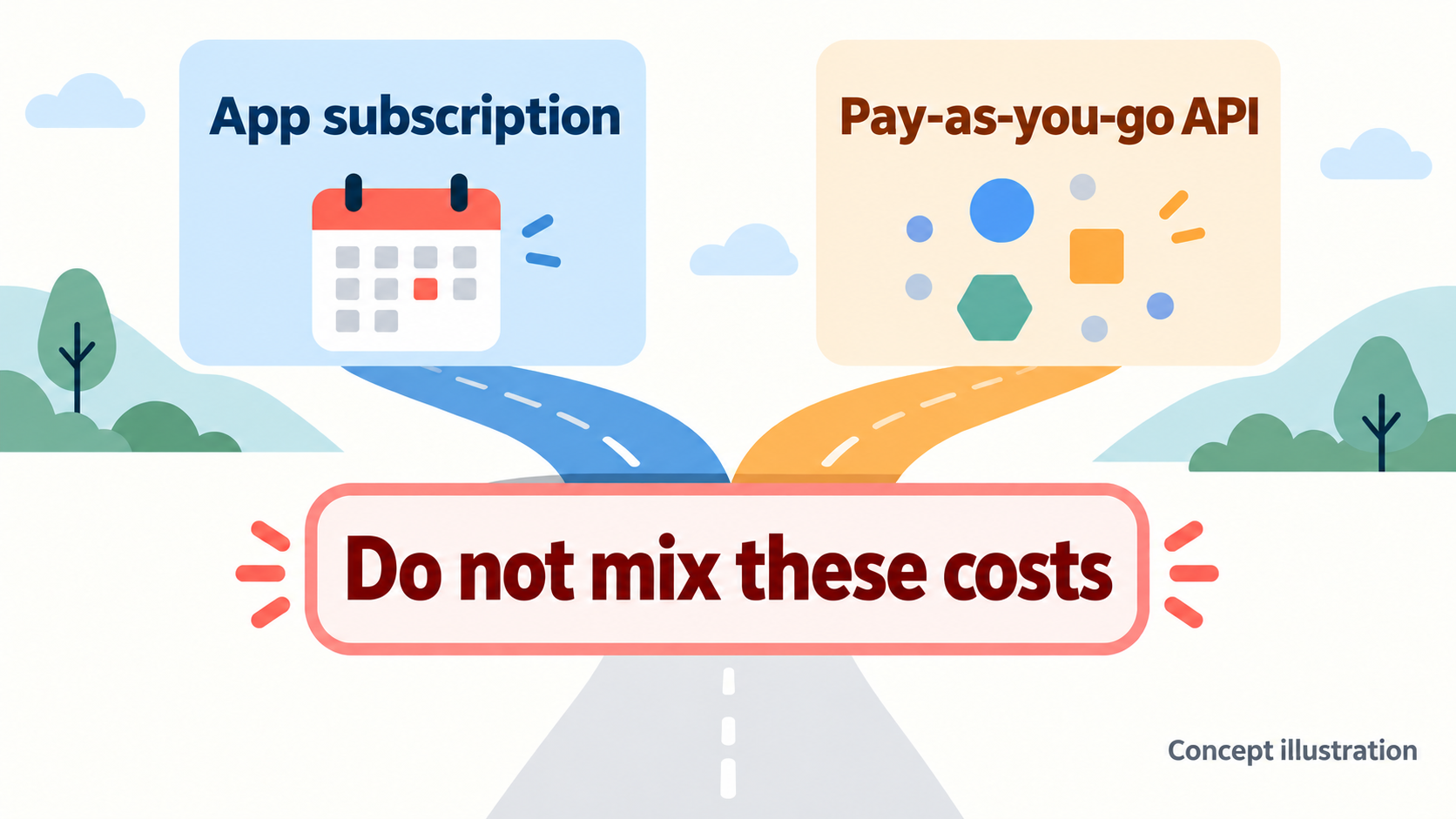
Figure: AI-generated illustration of billing bases, not a product bill; subscription monthly fees cannot be mixed with API unit prices. View full-size image (1672×941).

How to Choose by Task? Start with the Models You Have Available
If the task spans multiple software programs, or requires browsing the web, operating interfaces, and making complex judgments: try GPT-6 Astra first. OpenAI lists computer use, browsing, difficult programming, and professional documents as its key capabilities. If you already have a suitable ChatGPT paid account or API access, you can give it a real task today and see whether the result meets your requirements. OpenAI model description.
If the task is multi-hour coding, code review, or large-document work: try Claude Fable 5.1 first. Anthropic positions it for long-running autonomous tasks, complex programming, and research. Those who already have a Claude Code workflow can continue with familiar tools, but should first confirm whether their plan deducts additional usage credits; if you run many such tasks every day, then compare the real costs of Max and API. Anthropic model description.
Want to try Gemini 4 Argon: first confirm whether you have official access. Google's announced directions include complex programming, enterprise knowledge work, and defensive security tasks, and it has given proposed pricing; these are worth watching, but they cannot yet replace ordinary users' hands-on experience. If you do not have access, we do not recommend changing a running workflow for Argon's “expected to be cheaper.” Google official announcement.
These recommendations do not mean “if a model is good at one type of task, it can only do that type.” If all three become available in the future, the safest way to choose is: take the same real task, give the same materials and acceptance criteria, and separately record completion, manual rework, time spent, and total cost. A single impressive demo or each vendor's own benchmark scores cannot directly prove that your task will get the same result.
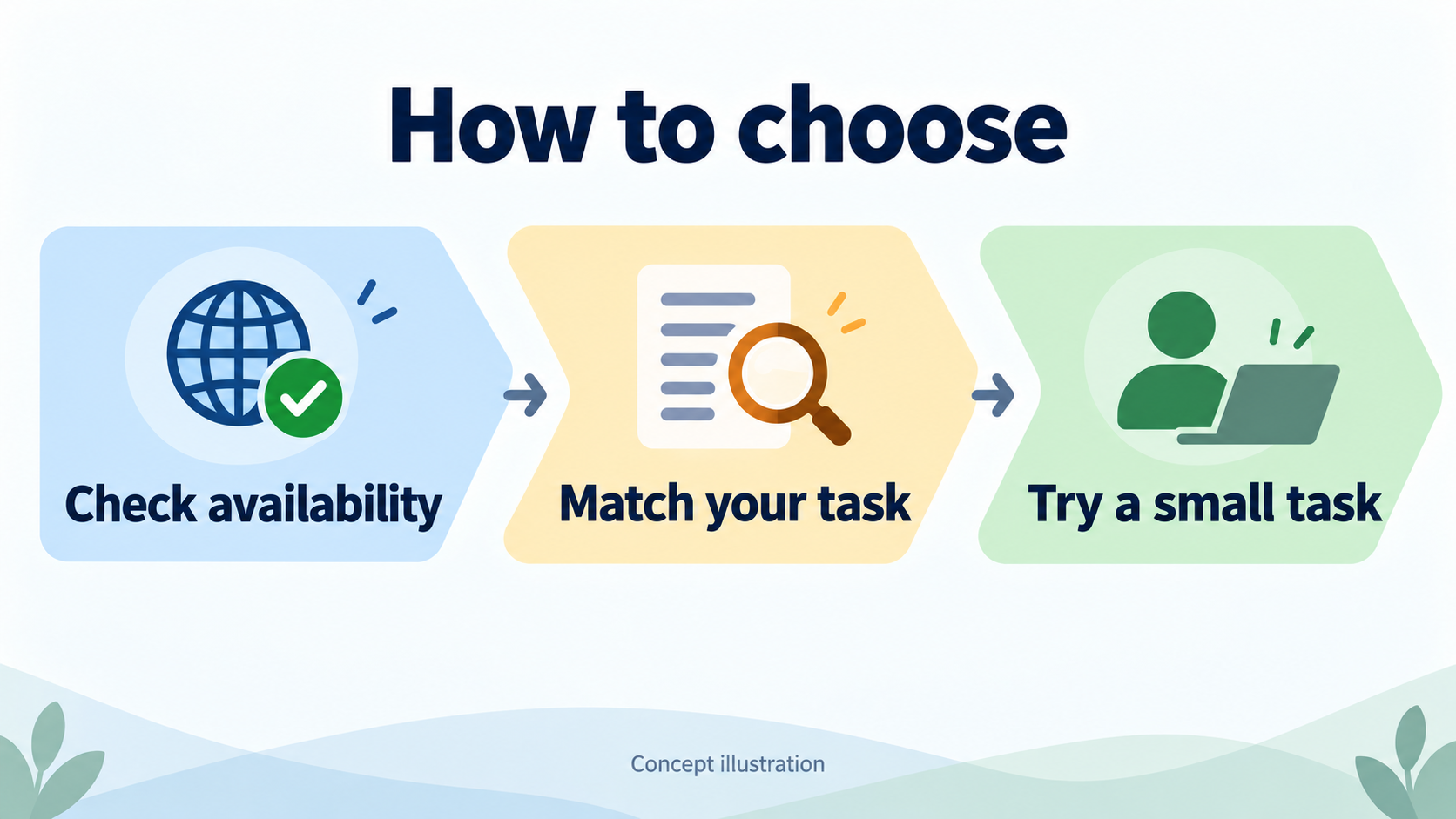
Figure: AI-generated illustration of the selection path: first check account and region availability, then task requirements, and finally verify with your own small task. The phrase “this article does not conduct any comparative testing” in the figure means we did not run same-condition tests ourselves; the benchmark table above transcribes data published by Google. View full-size image (1672×941).

If your task is to have two coding assistants divide the work, see Claude Code and Codex collaboration tutorial; if you want to send a specific problem to a logged-in ChatGPT Pro page, see Codex and Claude Code asking ChatGPT Pro for help tutorial. These two articles describe workflow operations and do not mean Gemini 4 Argon has been integrated into PandaNpc.
FAQ
Gemini 4 Argon has been officially released, so why can't I find it?
“Released” means Google announced the model and opened it to a limited scope; the official announcement has not yet given a unified availability date for all developers and ordinary consumers. First check the official model list for the Gemini product and account you use, and do not treat the rumored “Gemini 4 Pro” as an available entry point for Argon.
Is Astra Google's Project Astra?
No. GPT-6 Astra in this article is an OpenAI model; Google Project Astra is a separate research project and cannot be mixed into the three-model pricing table.
If I subscribe to Claude Pro, can I use Fable 5.1 within the plan quota?
Not necessarily. Anthropic's current plan description states that using Fable 5.1 on Pro requires usage credits, while some plans such as Max can use it within a limited weekly quota. Before paying, check your own “usage/credits” page.
Can I directly determine which is the most cost-effective based on the prices above?
No. The API table compares only list prices; completing a task is also affected by input length, whether repeated content hits the cache, tool fees, number of runs, and rework. In particular, Argon is not yet broadly available, so we cannot provide our own “cost per successful task.”
Related guides
GPT-6 Sol vs Claude Opus 5.5: How Should You Choose Based on Price, Benchmark Scores, and Coding Tasks?
For general API programming tasks, try GPT-6 Sol first; for complex tasks, compare Claude Opus 5.5, then consider GPT-6 Astra and Claude Fable 5.1 as high-difficulty options. This article checks the four models’ official specifications, caching and Batch pricing, and third-party benchmark scores on the same basis, and provides five reproducible cost scenarios.
Read article →
Codex vs Claude Code: Which Should You Use? (2026)
Codex vs Claude Code: choose Claude for terminal depth and hooks, Codex for ChatGPT/cloud work, and PandaNpc to control both across devices.
Read article →
How to use ChatGPT Pro with Codex and Claude Code in PandaNpc
Use ChatGPT Pro with Codex and Claude Code in PandaNpc: send a question to your signed-in ChatGPT browser and read its answer back in the original conversation.
Read article →