
GPT-6 Sol vs Claude Opus 5.5: How Should You Choose Based on Price, Benchmark Scores, and Coding Tasks?
For general API programming tasks, try GPT-6 Sol first; for complex tasks, compare Claude Opus 5.5, then consider GPT-6 Astra and Claude Fable 5.1 as high-difficulty options. This article checks the four models’ official specifications, caching and Batch pricing, and third-party benchmark scores on the same basis, and provides five reproducible cost scenarios.
Bottom line first: For general API coding tasks, start by trying GPT-6 Sol. Its standard input/output pricing is $2/$10 per million tokens, half that of Claude Opus 5.5. Under the highest-tier configuration in the same Artificial Analysis (AA) evaluation system, Opus 5.5 has an overall index of 58, while Sol has 48. The two are not in a “stronger at the same price” relationship: first compare pass rate, number of turns, total tokens, and manual rework on your own repository tasks, then decide whether to pay for Opus's higher scores. For harder long-horizon tasks, you can also go up to GPT-6 Astra or Claude Fable 5.1; the per-unit prices and capabilities of the four models do not rank in the same order.
We operate PandaNpc, which supports Codex and Claude Code, so we have product usage scenarios; this article has not completed a same-task hands-on test of all four models, and it does not pass off the public evaluations below as our own tests. Prices refer to model API costs, not tool subscription prices. Information was verified on September 23, 2026, and all currencies are USD.
Specs of the Four Models: First Distinguish Capacity, Output, and Default Tiers
To make mobile reading easier, the table below groups by OpenAI and Anthropic; “max output” is the single-response limit, and context is the total window available for input and output combined, which does not mean it can always produce the same length. API IDs can be used directly to verify billing or evaluation configurations.
| OpenAI spec | GPT-6 Sol | GPT-6 Astra |
|---|---|---|
| API model ID | gpt-6-sol |
gpt-6-astra |
| Official positioning | Balance of cost and capability | Most complex end-to-end tasks |
| Context window | 1,050,000 tokens | 1,050,000 tokens |
| Max output per request | 128,000 tokens | 128,000 tokens |
| Input/output modalities | Text, images → text | Text, images → text |
| Reasoning effort | none / low / medium / high / xhigh / max | low / medium / high / xhigh / max |
| Default effort | medium | Not listed on the official model page |
| Knowledge cutoff | 2026-04-20 | 2026-04-30 |
| Availability status | Available via API | Available via API |
- GPT-6 Sol
gpt-6-sol- GPT-6 Astra
gpt-6-astra
- GPT-6 Sol
- Balance of cost and capability
- GPT-6 Astra
- Most complex end-to-end tasks
- GPT-6 Sol
- 1,050,000 tokens
- GPT-6 Astra
- 1,050,000 tokens
- GPT-6 Sol
- 128,000 tokens
- GPT-6 Astra
- 128,000 tokens
- GPT-6 Sol
- Text, images → text
- GPT-6 Astra
- Text, images → text
- GPT-6 Sol
- none / low / medium / high / xhigh / max
- GPT-6 Astra
- low / medium / high / xhigh / max
- GPT-6 Sol
- medium
- GPT-6 Astra
- Not listed on the official model page
- GPT-6 Sol
- 2026-04-20
- GPT-6 Astra
- 2026-04-30
- GPT-6 Sol
- Available via API
- GPT-6 Astra
- Available via API
Data: GPT-6 Sol official model page, GPT-6 Astra official model page.
| Anthropic spec | Claude Opus 5.5 | Claude Fable 5.1 |
|---|---|---|
| API model ID | claude-opus-5-5 |
claude-fable-5-1 |
| Official positioning | Long-horizon agent coding and knowledge work | More difficult reasoning and long-horizon agent work |
| Context window | 1,000,000 tokens | 1,000,000 tokens |
| Max output per request | 128,000 tokens; up to 300,000 with Batch beta | 128,000 tokens |
| Input/output modalities | Text, images → text | Text, images → text |
| Reasoning mode | adaptive thinking, always on | adaptive thinking, always on |
| Default effort | medium | high |
| Knowledge cutoff | 2026-06 | 2026-06 |
| Availability status | Available via Claude API | Available via Claude API |
- Claude Opus 5.5
claude-opus-5-5- Claude Fable 5.1
claude-fable-5-1
- Claude Opus 5.5
- Long-horizon agent coding and knowledge work
- Claude Fable 5.1
- More difficult reasoning and long-horizon agent work
- Claude Opus 5.5
- 1,000,000 tokens
- Claude Fable 5.1
- 1,000,000 tokens
- Claude Opus 5.5
- 128,000 tokens; up to 300,000 with Batch beta
- Claude Fable 5.1
- 128,000 tokens
- Claude Opus 5.5
- Text, images → text
- Claude Fable 5.1
- Text, images → text
- Claude Opus 5.5
- adaptive thinking, always on
- Claude Fable 5.1
- adaptive thinking, always on
- Claude Opus 5.5
- medium
- Claude Fable 5.1
- high
- Claude Opus 5.5
- 2026-06
- Claude Fable 5.1
- 2026-06
- Claude Opus 5.5
- Available via Claude API
- Claude Fable 5.1
- Available via Claude API
Data: Opus 5.5 official model page, Fable 5.1 official model page. Opus's 300K output only applies to the specified Batch beta and the output-300k-2026-03-24 header; it is not the limit for ordinary interactive requests.
Billing for the Four Models: Standard Input, Cache Writes, and Cache Hits Are Different Tokens
The table below is all USD prices per million tokens, the unit price for the corresponding token category. Standard input does not have a “cache write fee” added on top; only tokens written to cache for the first time use the write price. After a cache hit, billing uses the read price, and output is still charged separately. Both companies offer a 50% Batch input/output discount, but Batch is asynchronous processing and is not suitable for coding conversations that need immediate feedback.
| OpenAI standard API | GPT-6 Sol | GPT-6 Astra |
|---|---|---|
| Standard input | $2.00 | $10.00 |
| Cache write | $2.50 | $12.50 |
| Cache read | $0.20 | $1.00 |
| Output | $10.00 | $50.00 |
| Batch input/output | $1.00 / $5.00 | $5.00 / $25.00 |
| Input over 272K | Entire request input and cache fees ×2, output fee ×1.5 | Entire request input and cache fees ×2, output fee ×1.5 |
- GPT-6 Sol
- $2.00
- GPT-6 Astra
- $10.00
- GPT-6 Sol
- $2.50
- GPT-6 Astra
- $12.50
- GPT-6 Sol
- $0.20
- GPT-6 Astra
- $1.00
- GPT-6 Sol
- $10.00
- GPT-6 Astra
- $50.00
- GPT-6 Sol
- $1.00 / $5.00
- GPT-6 Astra
- $5.00 / $25.00
- GPT-6 Sol
- Entire request input and cache fees ×2, output fee ×1.5
- GPT-6 Astra
- Entire request input and cache fees ×2, output fee ×1.5
Sources: Sol, Astra, OpenAI pricing page, OpenAI prompt caching guide. Going over 272K does not mean only the excess is priced higher; whether billing crosses the threshold is calculated based on the entire request's input tokens, including cache-related input.
| Anthropic standard API | Claude Opus 5.5 | Claude Fable 5.1 |
|---|---|---|
| Standard input | $4.00 | $10.00 |
| 5-minute cache write | $5.00 | $12.50 |
| 1-hour cache write | $8.00 | $20.00 |
| Cache read | $0.20 | $0.25 |
| Output | $20.00 | $50.00 |
| Batch input/output | $2.00 / $10.00 | $5.00 / $25.00 |
| 1M long context | Standard rates, no >200K premium | Standard rates, no >200K premium |
- Claude Opus 5.5
- $4.00
- Claude Fable 5.1
- $10.00
- Claude Opus 5.5
- $5.00
- Claude Fable 5.1
- $12.50
- Claude Opus 5.5
- $8.00
- Claude Fable 5.1
- $20.00
- Claude Opus 5.5
- $0.20
- Claude Fable 5.1
- $0.25
- Claude Opus 5.5
- $20.00
- Claude Fable 5.1
- $50.00
- Claude Opus 5.5
- $2.00 / $10.00
- Claude Fable 5.1
- $5.00 / $25.00
- Claude Opus 5.5
- Standard rates, no >200K premium
- Claude Fable 5.1
- Standard rates, no >200K premium
Sources: Opus 5.5, Fable 5.1, Anthropic pricing and Batch/caching rules, long-context documentation. Anthropic explicitly allows Batch and caching discounts to be combined; a cache hit must meet the corresponding validity period and identical-prefix conditions.
Specific Scores of the Four Models Under the Same Evaluation System
The table below is all from Artificial Analysis Intelligence Index v4.3.2. The test configuration is GPT-6 Sol max, GPT-6 Astra max, Claude Opus 5.5 and Fable 5.1 both adaptive reasoning max effort with default fallback enabled. These are not the default tiers of the four models; in particular, Opus defaults to medium and Fable defaults to high; even when different models are all marked max, actual reasoning token usage differs. AA unifies tasks and its own harness, so results can be compared horizontally within that test configuration; vendor launch-event scores cannot be mixed into this table. Links: Sol–Opus original comparison, Astra–Fable original comparison, AA methodology.
| AA overall and engineering tasks | Sol | Opus 5.5 | Astra | Fable 5.1 |
|---|---|---|---|---|
| Overall index v4.3.2 (score) | 48 | 58 | 53 | 53 |
| Terminal-Bench 4.0 (pass rate) | 44% | 60% | 59% | 52% |
| AutomationBench-AA (success rate) | 62% | 70% | 68% | 59% |
| SciCode (pass rate) | 58% | 67% | 56% | 63% |
| AA-LCR v1.1 long context (pass rate) | 84% | 85% | 81% | 85% |
- Sol
- 48
- Opus 5.5
- 58
- Astra
- 53
- Fable 5.1
- 53
- Sol
- 44%
- Opus 5.5
- 60%
- Astra
- 59%
- Fable 5.1
- 52%
- Sol
- 62%
- Opus 5.5
- 70%
- Astra
- 68%
- Fable 5.1
- 59%
- Sol
- 58%
- Opus 5.5
- 67%
- Astra
- 56%
- Fable 5.1
- 63%
- Sol
- 84%
- Opus 5.5
- 85%
- Astra
- 81%
- Fable 5.1
- 85%
Sources for each row are the above two AA same-version model comparison pages and the Astra–Fable page. For example, in AA's own Terminal-Bench 4.0 harness, Opus 5.5 is 16 percentage points higher than Sol; this cannot be mixed with Anthropic's official 66.4%, whose run settings are different.
| AA knowledge and professional tasks | Sol | Opus 5.5 | Astra | Fable 5.1 |
|---|---|---|---|---|
| AA-Briefcase v1.1 (Elo) | 1483 | 1822 | 1569 | 1678 |
| GDPval-AA v2.1 (Elo) | 1487 | 1846 | 1542 | 1735 |
| Humanity's Last Exam (pass rate) | 48% | 61% | 55% | 59% |
| GDP.pdf (overall pass rate) | 25% | 26% | 31% | 26% |
| CritPt (pass rate) | 31% | 32% | 32% | 30% |
| AA-Omniscience (index score, not percentage) | 27 | 46 | 43 | 43 |
- Sol
- 1483
- Opus 5.5
- 1822
- Astra
- 1569
- Fable 5.1
- 1678
- Sol
- 1487
- Opus 5.5
- 1846
- Astra
- 1542
- Fable 5.1
- 1735
- Sol
- 48%
- Opus 5.5
- 61%
- Astra
- 55%
- Fable 5.1
- 59%
- Sol
- 25%
- Opus 5.5
- 26%
- Astra
- 31%
- Fable 5.1
- 26%
- Sol
- 31%
- Opus 5.5
- 32%
- Astra
- 32%
- Fable 5.1
- 30%
- Sol
- 27
- Opus 5.5
- 46
- Astra
- 43
- Fable 5.1
- 43
Sources for each row: AA Sol–Opus, AA Astra–Fable. Small differences of 1–2 percentage points should not be interpreted as a solid win or loss; Elo, index scores, and pass rates are not the same unit either.
| AA test cost and usage | Sol | Opus 5.5 | Astra | Fable 5.1 |
|---|---|---|---|---|
| Average cost per index task | $1.06 | $5.98 | $3.26 | $7.63 |
| Average output tokens per task | 31K | 119K | 27K | 78K |
| of which reasoning tokens | 21K | 84K | 17K | 47K |
- Sol
- $1.06
- Opus 5.5
- $5.98
- Astra
- $3.26
- Fable 5.1
- $7.63
- Sol
- 31K
- Opus 5.5
- 119K
- Astra
- 27K
- Fable 5.1
- 78K
- Sol
- 21K
- Opus 5.5
- 84K
- Astra
- 17K
- Fable 5.1
- 47K
Sources are still AA Sol–Opus and AA Astra–Fable. Task cost is a weighted average of AA test usage, not a quote for “completing one requirement” in your repository. Opus's max configuration consumes more output and reasoning tokens, which is one reason the billing gap exceeds the unit-price gap.
Official Charts from Both Companies: They Can Verify Each Company's Own Conclusions, but Cannot Be Combined into a Head-to-Head Result
OpenAI's DeepSWE v1.1 chart gives GPT-6 Sol max at 68.8%, and Claude Fable 5's xhigh in the chart is 69.9%; there is no Opus 5.5. The horizontal axis is cost per task on a logarithmic scale. The Opus 5 in the chart is also not Opus 5.5. It shows that Sol, under the settings published by OpenAI, has coding agent scores close to higher-tier models, but it cannot replace a same-task test of the four models.
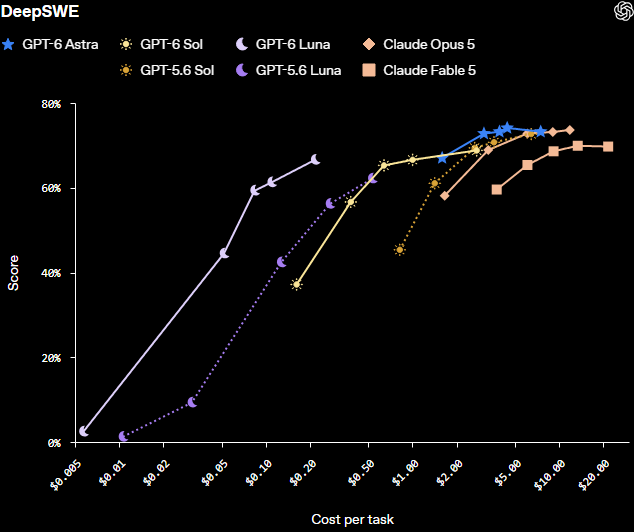
Figure 1: OpenAI, “Introducing GPT-6 Sol and Luna”, “Coding,” 2026-09-22. Models and effort are subject to the legend and footnotes in the original. Open the full original image to read the fine print.
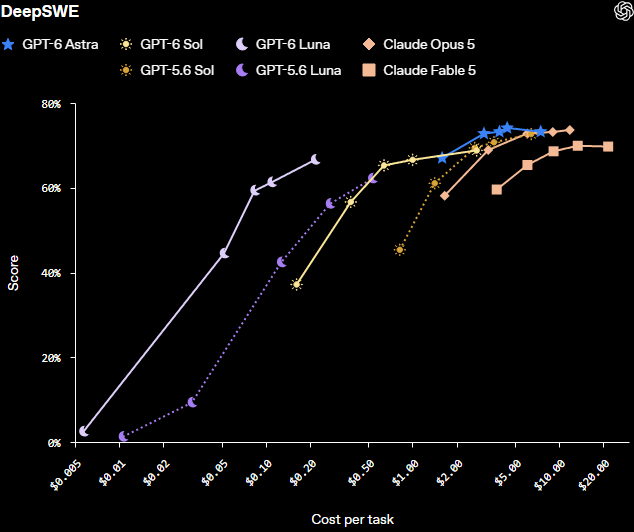
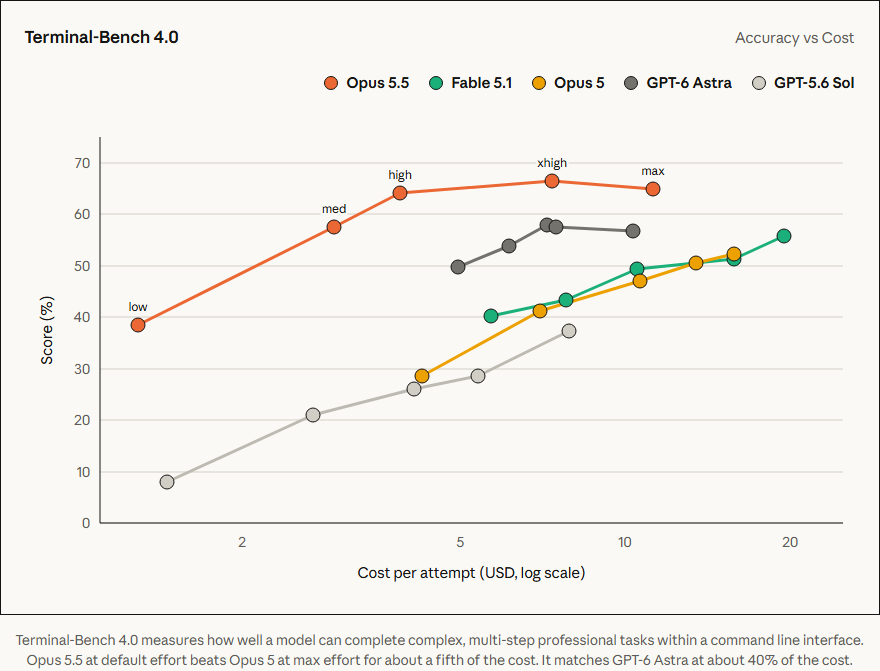
Anthropic's Terminal-Bench 4.0 chart gives Claude Opus 5.5 xhigh at 66.4%. GPT-6 Astra in the chart is 57.9% using high, not GPT-6 Sol. The curve also has points for default effort, but their positions cannot be treated as xhigh scores. The vendor harness here is different from the Terminal-Bench 4.0 in the AA table above, so you cannot subtract AA's 44% for Sol from 66.4%.
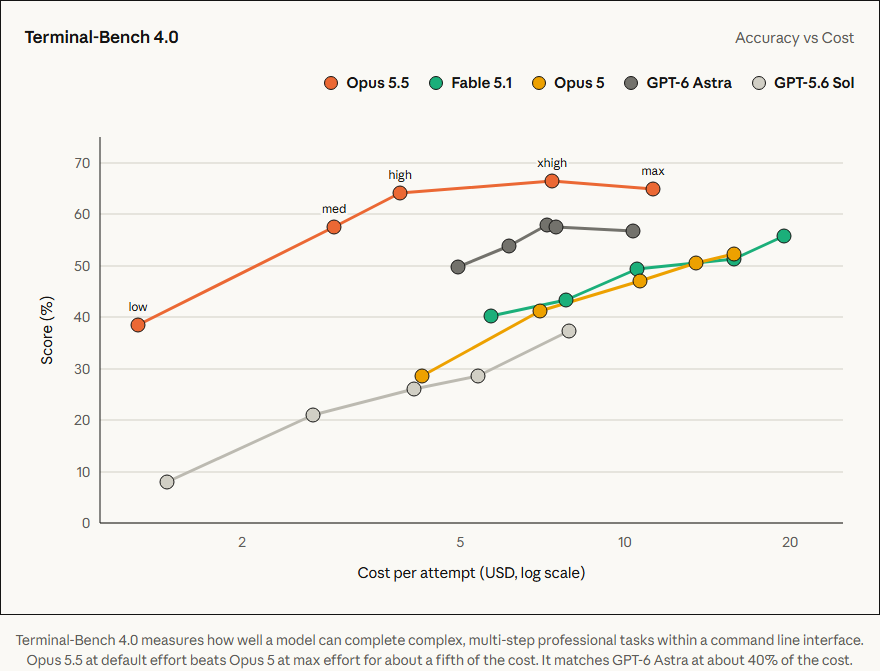
Figure 2: Anthropic, “Claude Opus 5.5”, “Coding,” 2026-09-22. The horizontal axis is cost per attempt on a logarithmic scale; see the original for the plotted tiers, statistical intervals, and limitations. Open the full original image to read the fine print.
There are also scores published unilaterally by vendors that should not be directly subtracted from each other: OpenAI reports Sol xhigh at 33.2% on AutomationBench 1.0.6, max at 56.4% on Agents' Last Exam V1, and xhigh at 60.5% on OSWorld 2.0 offline, sourced from the same OpenAI launch page; Anthropic reports Opus 5.5 at 54.4% on FrontierCode v1.1 Main, 57.8% on CursorBench 4.0, 1846 Elo on GDPval-AA v2.1, and 67.7% on Humanity's Last Exam with tools, sourced from the same Anthropic launch page. The versions, tools, effort, or harness of these items have not been confirmed to be consistent with the other side, so no “lead by how much” is listed. Unpublished same-scope values for the four models cannot be guessed.
How Much Does It Cost for the Same Task Volume? Five Reproducible Examples
Below, input is divided into three mutually exclusive token categories: standard, first cache write, and subsequent cache read, plus output. Each row is one request, excluding tool calls, platform surcharges, or extra turns; all outputs are below the 128K limit for ordinary requests. Prices are calculated according to the official prices above, so you can replace the token counts based on your own usage logs.
| Scenario and token usage | Sol | Opus 5.5 | Astra | Fable 5.1 |
|---|---|---|---|---|
| A Standard: 100K new input + 50K output | $0.70 | $1.40 | $3.50 | $3.50 |
| B First cache write: 200K write + 50K new input + 20K output | $0.80 | $1.60 (5m) / $2.20 (1h) | $4.00 | $4.00 (5m) / $5.50 (1h) |
| C Subsequent cache hit: 200K cache read + 50K new input + 20K output | $0.34 | $0.64 | $1.70 | $1.55 |
| D Async Batch version of A: 100K new input + 50K output | $0.35 | $0.70 | $1.75 | $1.75 |
| E Long input: 300K new input + 20K output | $1.50 | $1.60 | $7.50 | $4.00 |
- Sol
- $0.70
- Opus 5.5
- $1.40
- Astra
- $3.50
- Fable 5.1
- $3.50
- Sol
- $0.80
- Opus 5.5
- $1.60 (5m) / $2.20 (1h)
- Astra
- $4.00
- Fable 5.1
- $4.00 (5m) / $5.50 (1h)
- Sol
- $0.34
- Opus 5.5
- $0.64
- Astra
- $1.70
- Fable 5.1
- $1.55
- Sol
- $0.35
- Opus 5.5
- $0.70
- Astra
- $1.75
- Fable 5.1
- $1.75
- Sol
- $1.50
- Opus 5.5
- $1.60
- Astra
- $7.50
- Fable 5.1
- $4.00
Calculation examples: Sol for A = 0.1×$2 + 0.05×$10 = $0.70. Opus 5m for B = 0.2×$5 + 0.05×$4 + 0.02×$20 = $1.60; Opus for C = 0.2×$0.20 + 0.05×$4 + 0.02×$20 = $0.64. For E, Sol's input 300K has exceeded 272K, so the entire request is calculated at $4 input and $15 output; Astra corresponds to $20/$75. Opus/Fable's 1M context maintains standard rates. B and C are different requests, first write then read; C needs to ensure the cache is still valid. OpenAI's cache retention period and Anthropic's 5m/1h billing mechanism are different, so do not mistakenly add B's write fee to every request in C. Basis: OpenAI prices for the two models, Anthropic pricing rules.
How Should You Divide the Work When Putting Them into a Real Coding Workflow?
Let Sol run daily iterations first. Requirement breakdown, small changes to existing repositories, test patches, and work that can be reviewed in batches should be handled by Sol first, then record task success rate, rework count, and total tokens. Its low unit price is most direct in examples like A–D that do not cross 272K; the price advantage shrinks for ultra-long requests.
Let Opus 5.5 handle agent tasks that are hard to converge in one pass. AA's same-task tests give it higher scores on overall, terminal, and knowledge work, but under the max configuration its average cost per task is also clearly higher. You can first establish a local baseline with the default medium or the effort you actually use, then upgrade for difficult problems. Do not treat AA's max results as the default experience.
Astra and Fable 5.1 are the higher-reach tiers. Astra is competitive on AA's AutomationBench-AA, Terminal-Bench 4.0, and GDP.pdf, and Fable 5.1 is stronger on some long-horizon knowledge work metrics, but both have base input/output prices of $10/$50, significantly higher than Sol. Fable's cache read is $0.25, lower than Astra's $1.00; if the same large is read repeatedly, the cost ranking may change. For tasks, it is recommended to do a small-sample acceptance test of the four models on the same repository requirement, and by “cost of tasks successfully completed and mergeable,” not by a single leaderboard score.
In PandaNpc, Codex and Claude Code are two available Agent Engines. When choosing an entry point, you also need to consider your existing subscription or API channel, tool, repository context, and team review process; model API quotes cannot be directly converted into tool subscription quotas. This article presents public specs and evaluations, and does not claim a measured ranking of the four models within PandaNpc.
FAQ
Is Sol always half the price of Opus 5.5? Only the standard API input and output unit prices are each half. Input over 272K, cache writes and reads, actual reasoning tokens, turns, and tool fees all change the bill for the entire task. Scenario E above already narrows the two single-request prices to $1.50 and $1.60.
Do the two official coding charts prove who wins? No. OpenAI's chart does not include Opus 5.5, Anthropic's chart does not include Sol, and the benchmarks and harnesses are also different. To see same-task results for the four models, see the fixed-configuration table for AA v4.3.2; to decide your own tool selection, rerun your own repository tasks.
Can caching and Batch be combined? Anthropic's pricing documentation explicitly supports combining them; whether a cache is actually hit depends on the prefix, validity period, and request settings. For OpenAI's two models, Batch is 50% of the standard rate; for specific billing, check against the corresponding API usage records.
Related guides
GPT-6 Astra vs Claude Fable 5.1: Coding, Agents, Pricing, and Benchmark Comparison
GPT-6 Astra and Claude Fable 5.1 are both publicly available, and both are flagship models priced at $10 per million tokens for input and $50 per million tokens for output, but they have trade-offs in programming, computer operation, long tasks, cache costs, and context. This article uses a common benchmark to compare them item by item and provides a method for selecting models based on tasks.
Read article →
Codex Enable GPT-5.6 Sol 1M Context: 3-Line `config.toml` Configuration Tutorial
GPT-5.6 Sol officially supports a 1.05 million token context. Simply add 3 lines of configuration at the top of Codex's config.toml to run with a 1 million window, and it will automatically compact history at roughly 900,000 tokens. Includes permanent configuration, single command, verification, and cost reminders.
Read article →
Claude Fable 5.1 Comprehensive Analysis: Benchmarks, Improvements, Pricing, and Speed
Claude Fable 5.1's complete results across 7 mainstream benchmark categories, with item-by-item comparisons against Fable 5, Opus 5, and GPT-5.6 Sol, along with explanations of 5.1's long-task performance, tool calling, cache costs, speed, plan limits, and migration changes.
Read article →