
GPT-6 Astra vs Claude Fable 5.1: Coding, Agents, Pricing, and Benchmark Comparison
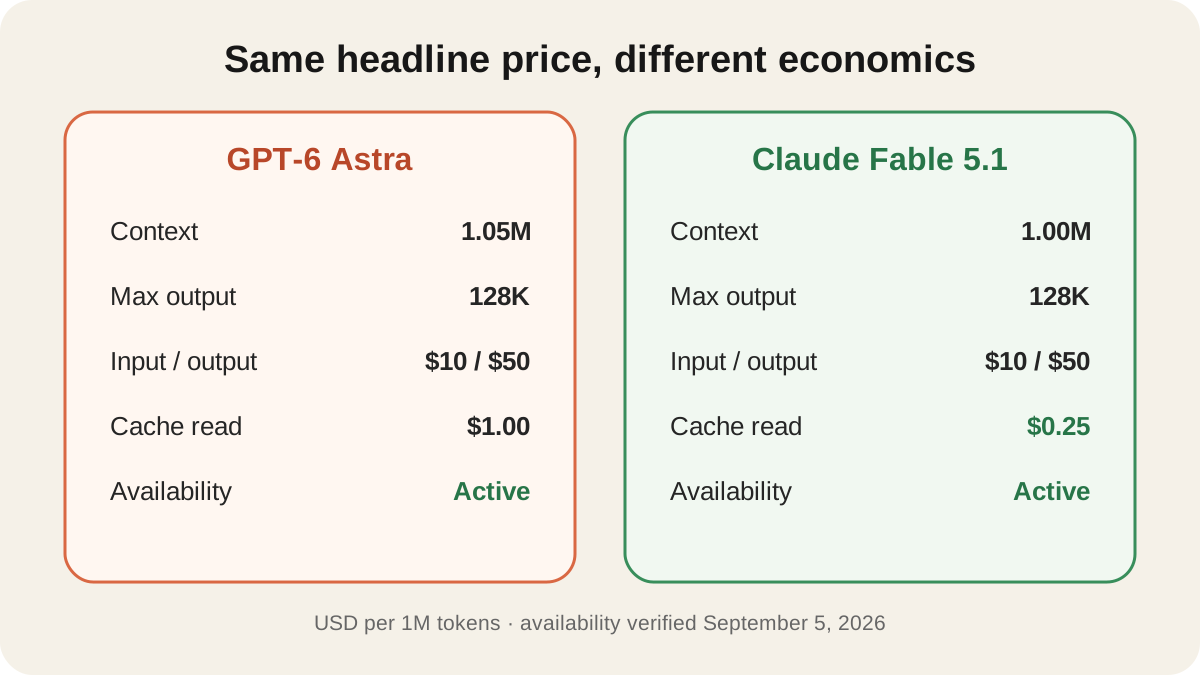
GPT-6 Astra and Claude Fable 5.1 are both publicly available, and both are flagship models priced at $10 per million tokens for input and $50 per million tokens for output, but they have trade-offs in programming, computer operation, long tasks, cache costs, and context. This article uses a common benchmark to compare them item by item and provides a method for selecting models based on tasks.
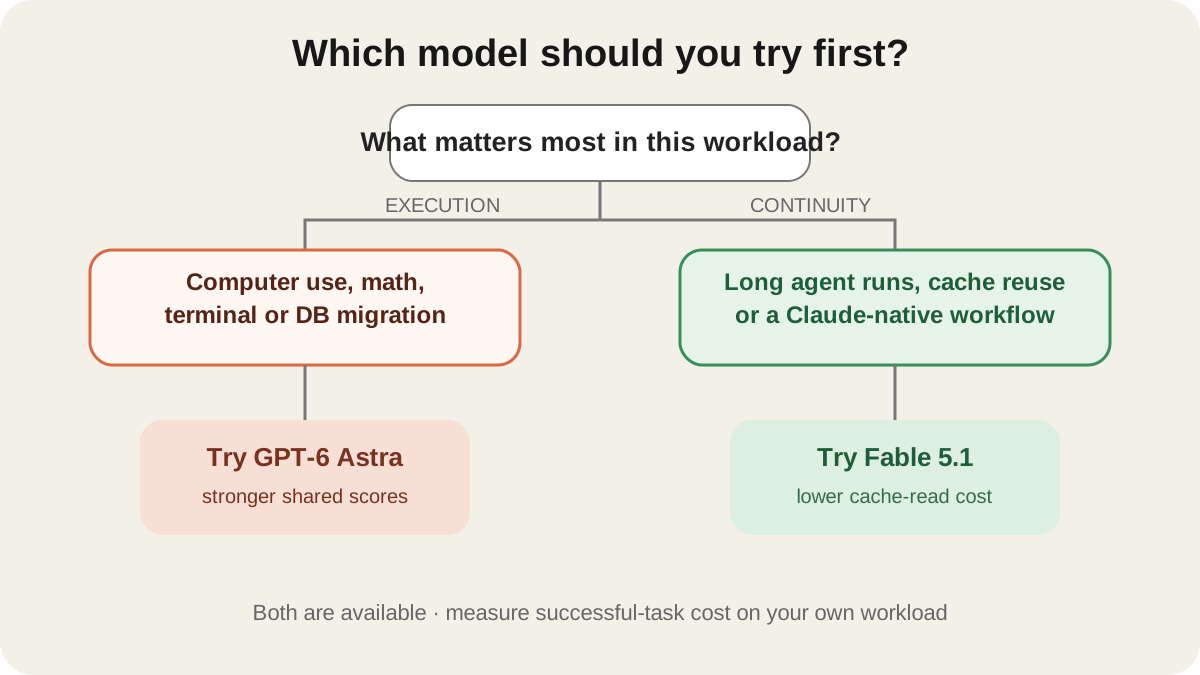
Bottom line first: GPT-6 Astra is the stronger all-round model on shared benchmarks, while Claude Fable 5.1 is more attractive for long-running agents, cache costs, and Claude Code workflows. If your tasks are mainly terminal coding, computer use, math, database migration, or cross-tool execution, try GPT-6 Astra first; if an agent will run continuously for hours, repeatedly re-read large contexts, or your team is already deeply invested in Claude Code, Fable 5.1 may still be the better fit.
This is not simply a matter of "how many benchmarks GPT-6 won." Both models have identical API input and output list prices, but cache reads differ by 4x; the vendor-published benchmarks also differ in harness, effort, safety policy, and missing data. As of September 5, 2026, this article compares only data that can be verified from official sources, and flags the places that cannot be directly compared.
GPT-6 Astra vs Claude Fable 5.1 at a Glance
| Item | GPT-6 Astra | Claude Fable 5.1 |
|---|---|---|
| Official positioning | Hardest end-to-end work | Hard reasoning and long-running agent work |
| Context window | 1,050,000 token | 1,000,000 token |
| Max output | 128,000 token | 128,000 token |
| API input price | $10 / MTok | $10 / MTok |
| API output price | $50 / MTok | $50 / MTok |
| Cache read | $1 / MTok | $0.25 / MTok |
| Cache write | $12.50 / MTok | 5 min $12.50 / MTok; 1 hr $20 / MTok |
| Batch | 50% of standard prices | 50% of standard input/output prices |
| Reasoning controls | low / medium / high / xhigh / max | Adaptive thinking; per-message effort settings |
| Reliable knowledge cutoff | April 30, 2026 | June 2026 |
| API model ID | gpt-6-astra |
claude-fable-5-1 |
| Availability as of 2026-09-05 | Fully available to eligible paid plans, Codex, and API | Available via the Claude API and major cloud platforms; available in Claude paid plans |
Specs are from the OpenAI GPT-6 Astra model page and the Anthropic Fable 5.1 model page. OpenAI also notes that when input exceeds 272K token, the input and cache prices for the entire request become 2x and the output price becomes 1.5x. So "GPT-6 has 50K more context" does not mean very long tasks are necessarily cheaper.
GPT-6 Astra's phased rollout is over, so "who gets access first" is no longer a major deciding factor between the two. "Full availability" here still refers only to eligible paid plans, Codex, and the API: Free/Go, GPT-6 Pro access in Chat, and restricted cyber safety capabilities still have separate boundaries. See GPT-6 Astra access and safety sharing notes.
GPT-6 Astra vs Claude Fable 5.1 Benchmark Comparison
Below are only the metrics where both sides have results, or where reason for a missing result is worth explaining. Scores come from official releases by both vendors. Bold indicates the higher value in a row; — only means the release table provided no data, not that the model scored zero.
| Capability | Benchmark | GPT-6 Astra | Fable 5.1 | Leader |
|---|---|---|---|---|
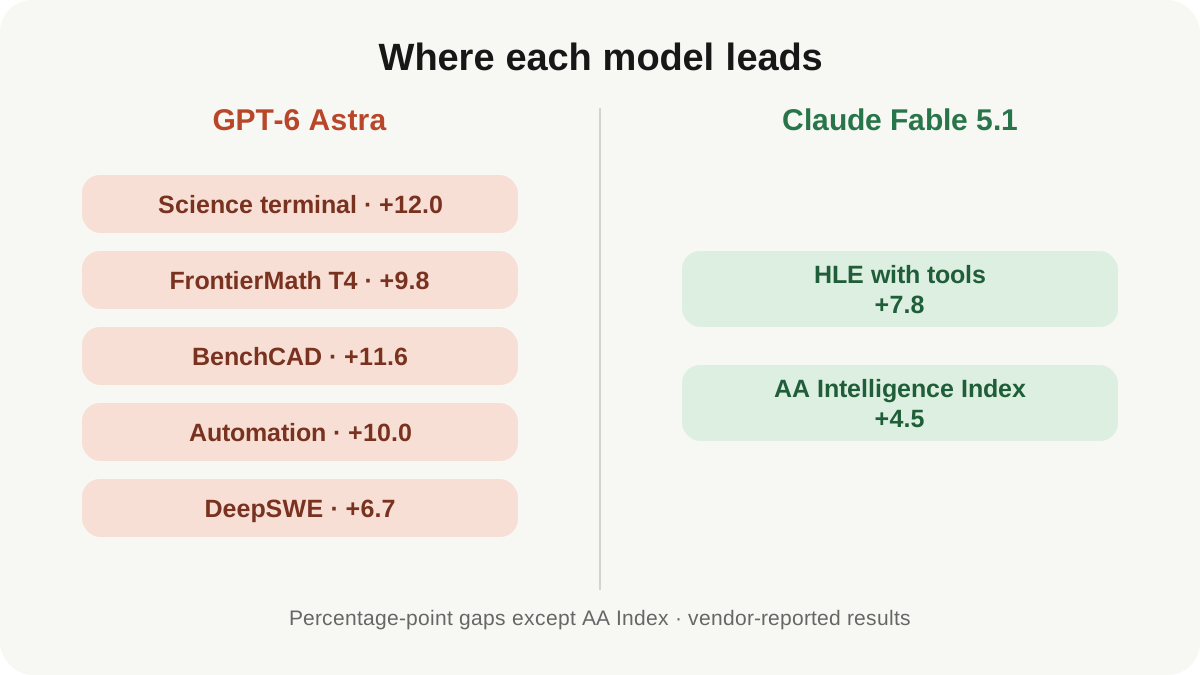
| Scientific terminal | Terminal-Bench Science | 64.6% | 52.6% | GPT-6 +12.0 |
| Hard math | FrontierMath Tier 4 | 97.6% | 87.8% | GPT-6 +9.8 |
| Science Q&A | GPQA Diamond | 96.0% | 93.7% | GPT-6 +2.3 |
| Multidisciplinary reasoning | HLE (with tools) | 57.2% | 65.0% | Fable +7.8 |
| Health Q&A | HealthBench Pro | 63.4% | 56.6% | GPT-6 +6.8 |
| Business automation | Automation | 41.4% | 31.4% | GPT-6 +10.0 |
| CAD | BenchCAD | 95.9% | 84.3% | GPT-6 +11.6 |
| General intelligence | AA Intelligence Index | 61.2 | 65.7 | Fable +4.5 |
| Terminal coding | Terminal-Bench 4.0 | 57.7% | 55.8% | GPT-6 +1.9 |
| Software engineering | DeepSWE v1.1 | 74.1% | 67.4% | GPT-6 +6.7 |
| Extended coding | FrontierCode Ext. | 64.5% | 63.6% | GPT-6 +0.9 |
| Mainline coding | FrontierCode Main | 53.3% | 50.9% | GPT-6 +2.4 |
| Database migration | DB Migration | 63.9% | 57.8% | GPT-6 +6.1 |
| Abstract reasoning | ARC-AGI-2 | 95.0% | 90.0% | GPT-6 +5.0 |
| Abstract reasoning | ARC-AGI-1 | 98.5% | 97.5% | GPT-6 +1.0 |
These numbers support three limited conclusions:
- GPT-6 Astra's advantage covers a broader range, especially scientific terminal, math, CAD, business automation, and database migration.
- Fable 5.1 is not behind across the board; it is higher on the HLE tool-use setting and the Artificial Analysis Intelligence Index.
- Gaps of less than two or three percentage points should not be over-interpreted. Who runs the evaluation, the samples, tools, reasoning budget, or randomness can all move the ranking.
OpenAI's release materials also list Agents' Last Exam 59.3%, OSWorld 2.0 72.6%, and ScreenSpot-Pro 92.7%, but the same table has no corresponding Fable 5.1 values, so those rows cannot be used to declare Fable a failure. Conversely, CursorBench 3.2.0, GDPval-AA v2, and OSWorld partial/strict from Anthropic's release page cannot be stitched directly onto OpenAI's numbers, which use a different configuration.
Coding Ability: GPT-6 Is Stronger, but the Gap Depends on the Task
If the question is "which is better for coding, GPT-6 Astra or Fable 5.1," the official shared data favors GPT-6: 1.9 points higher on Terminal-Bench 4.0, 6.7 higher on DeepSWE v1.1, and 6.1 higher on DB Migration. Its results on ScreenSpot-Pro, BenchCAD, and Computer Use–related tasks also suggest it is not just good at generating code but also at completing tasks inside real software interfaces.
But different coding benchmarks are not measuring the same thing:
- Terminal-Bench is closer to understanding an environment in the terminal, modifying files, and passing verification;
- DeepSWE focuses on software engineering tasks;
- FrontierCode puts more emphasis on real-world code quality and mergeability;
- DB Migration is a narrower but very practical database-change task;
- The Artificial Analysis Coding Agent Index aggregates multiple agentic coding evals, where Fable 5.1 remains competitive on some external aggregate metrics.
So for small fixes or single-file generation, you should not choose a model based on flagship benchmarks alone. What you should actually A/B test is your own representative tasks: the same repository, the same initial state, the same tool permissions, and the same acceptance tests, recording success rate, number of human interventions, total token, total cost, and time to completion separately.
Long-Running Agents: Fable 5.1's Advantage Is Not Only in Benchmarks
Anthropic explicitly designed Fable 5.1 as a task model that runs for hours and spans multiple applications. It emphasizes planning, tool invocation, failure recovery, self-testing, and readable progress, and supports per-message effort adjustment. For teams that have already built workflows around Claude Code, Cowork, or the Claude API, these runtime behaviors may matter more than a few extra points on a single benchmark.
GPT-6 Astra is also built for end-to-end agents, supporting web search, file search, a code interpreter, a hosted Shell, Computer Use, MCP, Skills, and asynchronous tool calls. It also supports adding requirements while a task is running and adjusting reasoning intensity without interrupting the cache prefix. In other words, neither model is "chat only"; the differences show up more in agent frameworks, ecosystem integration, and cost structure.
If a task will run for several hours, you can view Claude Code or Codex sessions running on your local machine from mobile, web, or desktop through PandaNpc Agent. The model and tools still execute on the development machine; the remote entry point only lets you watch progress, handle permission issues, and issue further instructions. See also Claude Code vs Codex.
Same Prices, but Real Costs Can Differ a Lot
Both models charge $10/MTok input and $50/MTok output, so looking only at the headline price you would assume the cost is the same. In practice there are at least four variables:
- Cache read: Fable 5.1 is $0.25/MTok; GPT-6 Astra is $1/MTok;
- Very long input: GPT-6 triggers multiplier billing for the entire request after input exceeds 272K;
- Output length: Output is $50 per million token for both, so rework and verbose reasoning quickly amplify costs;
- Task success rate: A more expensive model that finishes in one pass can be cheaper than a cheaper model that has to run three times.
Assume a task reads 10 million cached token, plus 200K new input and 50K output, ignoring cache writes for now:
| Cost | GPT-6 Astra | Fable 5.1 |
|---|---|---|
| Cache read | $10.00 | $2.50 |
| New input | $2.00 | $2.00 |
| Output | $2.50 | $2.50 |
| Total | $14.50 | $7.00 |
This example only illustrates the price difference in a "high cache reuse" scenario; it does not mean Fable is half the price for every task. If a task barely hits the cache, or GPT-6 finishes in one pass with fewer steps, the outcome can flip.
How Safety Policy Affects Real Usage
Fable 5.1's cyber, biological, and chemical requests may trigger safeguards, causing them to be declined or routed to an Opus model. Anthropic explicitly states that routed requests are not billed at Fable prices. Its official benchmarks also note that some tasks scored zero because production safety policy intervened, so "refused to answer" and "insufficient underlying capability" are not the same thing.
GPT-6 Astra also adopts stricter safety and alignment mechanisms. OpenAI rates its cyber capabilities as Critical and applies Trusted Access, monitoring, and tiered release to high-risk capabilities. Ordinary development, code review, and defensive security work usually do not count as high-risk capabilities, but whether a request can actually run still depends on the request content, account eligibility, and tool permissions.
This is also why safety benchmarks should not be read by "completion rate" alone. For enterprise deployment, the more important questions include: Is automatic execution allowed? Can tool permissions be restricted? Is an audit trail retained? What are the data retention rules? And when a fallback is triggered, can the application correctly identify which model is actually being used?
How to Choose Between GPT-6 Astra and Fable 5.1
Choose GPT-6 Astra first if you:
- Mainly do complex terminal coding, database migration, computer use, or cross-tool work;
- Care more about shared benchmark results in math, abstract reasoning, CAD, and professional software operation;
- Need the OpenAI Responses API's combination of asynchronous tools, hosted Shell, Computer Use, or MCP;
- Want to use Astra directly in the now-open Codex or OpenAI API and are willing to account for multiplier billing on long inputs above 272K.
Choose Claude Fable 5.1 first if you:
- Already use Claude Code or the Claude API as your primary workflow;
- Have tasks that run for a long time and repeatedly read large identical contexts;
- Care more about cache read cost, readable progress, and long-task recovery;
- Your own evaluations show Fable requires less rework on codebase or professional document tasks.
If you have access to both, the safest approach is not to bet on a single overall winner but to build two-tier routing: use cheaper Opus, Sonnet, or GPT-5.6 models for ordinary tasks; escalate only high-value, long-chain tasks to GPT-6 Astra or Fable 5.1, and keep routing based on measured success rates.
How to Compare the Two Models Fairly
Prepare 10–30 real tasks, and for each task hold fixed:
- The same code and data snapshot;
- The same tool, network, and file permissions;
- Equivalent reasoning effort, rather than max on one side and the default setting on the other;
- The same time limit and cost cap;
- An automated test or blinded human review criterion;
- At least three repeated runs, so a single lucky success is not treated as a stable capability.
The final table should record at least completion rate, first-pass rate, number of human interventions, total cost, elapsed time, and output token. If a model triggers a refusal, downgrade, or insufficient permissions, list the reason separately rather than counting it all as "can't do it."
FAQ
Is GPT-6 Astra stronger than Claude Fable 5.1?
On most shared benchmarks released so far, GPT-6 Astra is higher, especially scientific terminal, math, CAD, automation, and database migration. But Fable 5.1 leads on the HLE tool-use setting and the AA Intelligence Index, and real tasks are also affected by harness, effort, tools, and safety policy.
Which model is better for writing code?
GPT-6 Astra generally wins on shared coding benchmarks and suits terminal, database, and cross-software tasks; Fable 5.1 places more emphasis on long-running autonomous coding, recovery, and verification. For large projects, the best approach is same-condition A/B testing on your own codebase.
Are their API prices the same?
Base input and output prices are the same: $10/MTok and $50/MTok. But Fable 5.1 cache reads cost only $0.25/MTok while GPT-6 Astra costs $1/MTok; GPT-6 also triggers multiplier billing above 272K input, so the actual cost is not necessarily the same.
Which has the longer context?
GPT-6 Astra has 1,050,000 token and Fable 5.1 has 1,000,000 token, with a 128K max output for both. On capacity alone the gap is small; the price of very long input, retrieval quality, and cache hit rate are usually more worth paying attention to.
Why can't I see GPT-6 Astra?
As of September 5, 2026, GPT-6 Astra is fully available to eligible paid plans, Codex, and API entry points. If you still cannot see it, check whether you are on Free/Go, whether you are looking for base Astra or GPT-6 Pro, whether your workspace admin allows the model, and whether your client needs an update or a re-login. Full boundaries are in the GPT-6 Astra access and sharing notes.
Can vendor benchmarks be trusted directly?
You can treat them as a screening signal, but not as the final purchasing conclusion. First confirm that the same row uses the same task version, tools, reasoning budget, and scoring method, then re-test with your own representative workloads.
Summary
The key to GPT-6 Astra vs Claude Fable 5.1 is not "which one is smarter in every scenario." Both models are publicly available; GPT-6 leads on most shared benchmarks and is especially suited to computer use, complex terminal work, math, and cross-tool execution; Fable 5.1 retains a clear advantage through lower cache read cost, mature Claude workflows, and a long-running agent design.
If there is only one default recommendation: if you have access and your tasks skew toward complex execution, try GPT-6 Astra first; if your tasks heavily reuse long context or are deeply tied to Claude Code, try Fable 5.1 first. For teams sensitive to cost or reliability, the final decision should be based on your own success rate and the cost per successful task.
Related guides
Claude Fable 5.1 Comprehensive Analysis: Benchmarks, Improvements, Pricing, and Speed
Claude Fable 5.1's complete results across 7 mainstream benchmark categories, with item-by-item comparisons against Fable 5, Opus 5, and GPT-5.6 Sol, along with explanations of 5.1's long-task performance, tool calling, cache costs, speed, plan limits, and migration changes.
Read article →
Is GPT-6 Astra Available Now? How to Safely Share It with Family and Friends
Yes — GPT-6 Astra is now fully available to eligible paid plans, Codex, and the API. This article explains the permission differences among Plus, Pro, Business, Enterprise, Free/Go, and GPT-6 Pro, and demonstrates how to securely share via revocable Agent connections without sharing OpenAI account passwords or API Keys.
Read article →
Codex vs Claude Code: Which Should You Use? (2026)
Codex vs Claude Code: choose Claude for terminal depth and hooks, Codex for ChatGPT/cloud work, and PandaNpc to control both across devices.
Read article →